
The Moravian Karst is not just nature. People were smelting iron here as early as the end of the 8th century, an armaments factory and a secret command post hid in the caves, and one man, Karel Absolon, turned them into a tourist attraction at the start of the 20th century. This week takes you through three stories: Absolon and the exploration of the caves, iron and craft, and the 20th century, from an armaments factory to a church built under communism.
On Monday almost everything is closed: the Blansko Region Museum, the castle, the chateau and the synagogue in Boskovice, and the Blaník Knights Cave. The plan therefore treats Monday as Day 1 (Punkva Cave and Macocha, but check the opening hours, as outside the season it is closed on Mondays). Move Days 2, 5 and 6 so that they don’t fall on a Monday.
Prices and opening hours are from 2026. Check them with the operators before you travel; the links are at the bottom.
In 2027 it will be 150 years since the birth of Karel Absolon (16 June 1877, Boskovice). We don’t yet know the official programme of celebrations, and this plan does not count on it.
What to know in advance
- A car comes in handy. Boskovice, Rudka and Senetářov lie outside the main centre of the karst. From Blansko to Boskovice it is 14 km and about 20 minutes, to Rudka about 22 km.
- It is around 7–10 °C in the caves all year round. Bring a warm layer.
- Keep the ticket from one cave. With a ticket from another Moravian Karst cave, no more than a month old, you get 20% off (it does not apply to Punkva Cave). So visit Punkva Cave first.
- Base: Blansko (the train, the museum and the best connections) or Sloup (closer to Boskovice). You’ll find accommodation tips in our article Where to Stay in the Moravian Karst.
Day 1: Punkva Cave and Macocha, the story of Karel Absolon
Time: the cave in the morning, Macocha in the afternoon. Getting there: from the car park at Skalní Mlýn (150–200 CZK per day) it is 1.6 km along a flat path to Punkva Cave, or 10 minutes by the little tourist train (110 CZK one way). What to expect: the tour (1,250 m, 198 steps, about 50 minutes) ends with a boat ride along the underground Punkva river. It was Karel Absolon who had it made navigable: in 1909 his expedition discovered the dry part of the caves, from spring 1914 you could walk to the bottom of Macocha, and on 1 July 1933 the boat trips began. Admission is 450 CZK for adults and 350 CZK reduced in season, 350 and 270 CZK outside the season. Afternoon: by cable car or on foot to the Upper Platform (from 1882) and the Lower Platform (from 1899), both free. Booking: in season, ahead. If it rains: no problem.
Day 2: The Blansko Region Museum and Blansko
Time: half a day to a whole day. What to expect: the chateau in the centre of Blansko is the seat of the Blansko Region Museum. On a single tour you see how the karst was explored from Wankel to Absolon, finds from Býčí skála, the cavers’ equipment in a 15th-century cellar, and upstairs the artistic cast ironwork of Blansko made famous by the Salm family. The permanent exhibitions are guided, 100 CZK for adults, family ticket 200 CZK. Open: from April to October Tuesday to Sunday 10–17, from November to March Tuesday to Saturday. Closed on Mondays. If it rains: ideal. To read: on Absolon and his controversies see Karel Absolon: The Man Who Opened Punkva Cave. He was a brilliant organiser, but stubborn and intolerant of criticism.
Day 3: The iron karst: Josefov Valley and Stará huť
Time: a whole day. Getting there: by train to Adamov. The Adamov–Křtiny bus also goes to Stará huť (stop Adamov, Stará huť); on foot it is about 5 km from Adamov along the blue trail. What to expect: Stará huť near Adamov, a national cultural monument, has the 10-metre-high charcoal-fired furnace František and, in the former pattern shop, an exhibition on ironworking. Admission is 60 CZK (reduced 30 CZK), cash only. It is open in April and October on Saturdays, Sundays and public holidays, from May to September Wednesday to Sunday and on public holidays, always 9–12 and 13–17, last entry 16:30. So don’t plan Day 3 for a Monday or Tuesday. Iron was smelted here from the end of the 8th century, and the Moravian Karst is the largest archaeologically explored centre of iron smelting among the western Slavs. Walk: an educational trail runs through Josefov Valley (sources give 2 to 5 km) and passes through the Jáchymka cave. Take a torch and sturdy shoes, as the caves are unlit. Býčí skála: the cave is normally closed and opens only exceptionally on open days. Getting back: work it out beforehand and check it at idos.cz. If it rains: Stará huť is mostly outdoors, so expect a shorter visit.
Day 4: Výpustek and Křtiny, the 20th century inside a hill
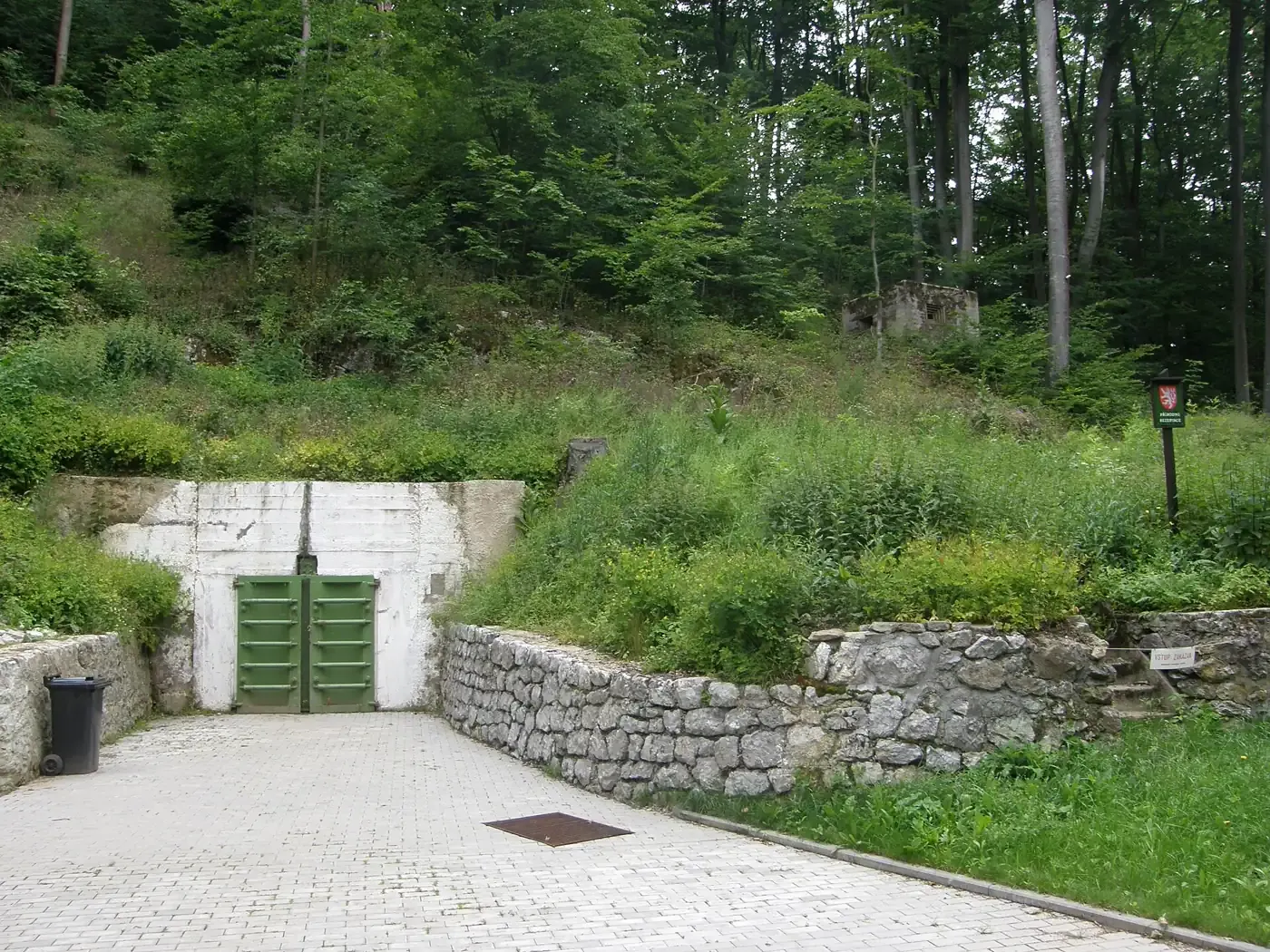
Time: Výpustek in the morning, Křtiny and Senetářov in the afternoon. Výpustek: around 1600, doctors came here from all over Central Europe for bones sold as “unicorn horn”. In the Second World War it housed a Nazi armaments factory for aircraft engines with 1,200 workers a day, and from 1961 to 2001 a top-secret command post of the Czechoslovak army, designed to survive an atomic explosion of 30 kilotons. The cave opened to the public in 2008. The long route (600 m, about 75 minutes) costs 230 CZK, the short one (450 m, about 40 minutes) 160 CZK. Křtiny: the Baroque pilgrimage church of the Name of the Virgin Mary by Jan Blažej Santini is open daily free of charge (shorter hours in winter). Senetářov: the Church of St Joseph from 1969–1971 is one of the few churches built under communism. It was designed by the painter Ludvík Kolek after the chapel at Ronchamp. The village had promised it in 1944 before a forced relocation, believers worked more than 30,000 hours on the site, and it was consecrated only in 1991. Admission is free, and it is usually open during services. If it rains: Výpustek and the church are under cover.
Day 5: Boskovice, the birthplace of Karel Absolon
Time: a whole day. Getting there: by car from Blansko or Sloup about 20 minutes. The castle, the chateau and the Jewish quarter are a few minutes’ walk from each other. What to expect: the castle ruin with a 26 m deep cistern and a treadwheel (unguided, full admission 140 CZK; the price list on the castle’s website is marked as valid for 2024, so check it), the Empire-style chateau of the Mensdorff-Pouilly family (tour about 45 minutes, 180 CZK) and the Jewish quarter with the Synagogue Maior of 1639. Karel Absolon was born in Boskovice on 16 June 1877. Open: closed on Mondays. The chateau is open only in some months (in April and October only for booked groups); check the castle and the synagogue in advance. If it rains: the chateau and the synagogue are under cover, the castle is not.
Day 6: Rolínek: the Blaník Knights Cave and the Hussites
Time: half a day to a whole day. Getting there: by car; Rudka is about 22 km from Blansko, around 25 minutes from the karst. It lies outside the karst, to the north of it. What to expect: Stanislav Rolínek (1902–1931) was an upholsterer from Bořitov who taught himself sculpture. In Rudka he created the Blaník Knights Cave with St Wenceslas on horseback and a stone lion at the entrance, but he did not finish it and died at 29. The guided tour takes 25–30 minutes, adults pay 150 CZK, it is closed on Mondays and closed in January, February and December. The Hussites: the sculpture group on Velký Chlum near Bořitov (from 1927) is freely accessible; a car can’t get to it, so you walk from Bořitov. Blue-dye printing in Olešnice: if you are travelling on a Tuesday or Thursday in summer, add the Danzinger blue-dye printworks (since 1816, tour about 50 minutes, 120 CZK for adults). Without a reservation, individuals can join from 2 May to 27 September, on Tuesdays and Thursdays at 13:30 and 14:30 (2026 data). If it rains: the cave is under cover, the sculptures are not.
Day 7: Hidden stories and a spare day
Leave the last day for whatever interested you most. Options include:
- The lost village of Bystřec in Rakovecké Valley, about 4 km south-east of Jedovnice. What remains is a meadow with mounds where the houses stood. Archaeologists uncovered the whole layout of the village (19 farmsteads). Sources differ on when it was abandoned. It is freely accessible, you walk from Jedovnice along the marked trail, and it is often muddy after rain.
- Kateřinská Cave, where archaeologists found prehistoric charcoal drawings and shell beads more than 8,000 years old. You won’t see the drawings on the regular tour; the dates of the special archaeological tour are in the news section of the cave’s website.
- Lime kilns: the shaft kiln of the Velká dohoda lime works in Lipovec from 1928 is freely accessible, but according to its own website the site stays closed until spring 2027.
- Stories to read: Hugo Václav Sáňka, the head teacher from Rudice who pushed for gates on the caves, and Ladislav Slezák, the geologist who was removed as head of the caves in 1974.
What it costs
For admission on Days 1 to 6 an adult pays roughly 1,310 CZK: Punkva Cave 450 CZK, the museum 100 CZK, Stará huť 60 CZK, Výpustek 230 CZK (long route), the castle in Boskovice 140 CZK, the chateau 180 CZK and Rudka 150 CZK. On top of that come parking at 150–200 CZK at Skalní Mlýn, the little train and petrol. With the 20% discount on a ticket from another cave you save at Výpustek and in Rudka.
Frequently asked questions
Is the week suitable for children? More for school-age children. For younger children the family week is better.
Can you manage the week without a car? Days 1 to 3, yes: by train to Blansko, bus no. 226 to Skalní Mlýn and by train to Adamov. Boskovice, Rudka and Senetářov are complicated without a car; check the connections at idos.cz.
What if it is Monday? Spend Monday on Punkva Cave and Macocha (check the opening hours) and shift the other days.
→ More week plans: pick your week in the Moravian Karst
Information verified on 24 November 2026. Prices and opening hours change, so check them before you travel: Caves Administration of the Czech Republic, Blansko Region Museum, Technical Museum in Brno, Boskovice Castle, Boskovice Chateau, Museum of the Boskovice Region.
Where to stay in the Moravian Karst
All accommodation →Guesthouses, cabins and hotels around the caves and the Macocha Abyss. The map compares listings from Booking.com, Airbnb and other sources — you book directly, without switching between sites.
Accommodation links are affiliate links — if you book through them we get a small commission, at no extra cost to you.
Spotted a mistake or an out-of-date detail? Tell us.
Complete 7-day itinerary — free
Get a detailed week-long plan sent to you: caves, Macocha, day trips, where to stay. The PDF arrives by email right away.