
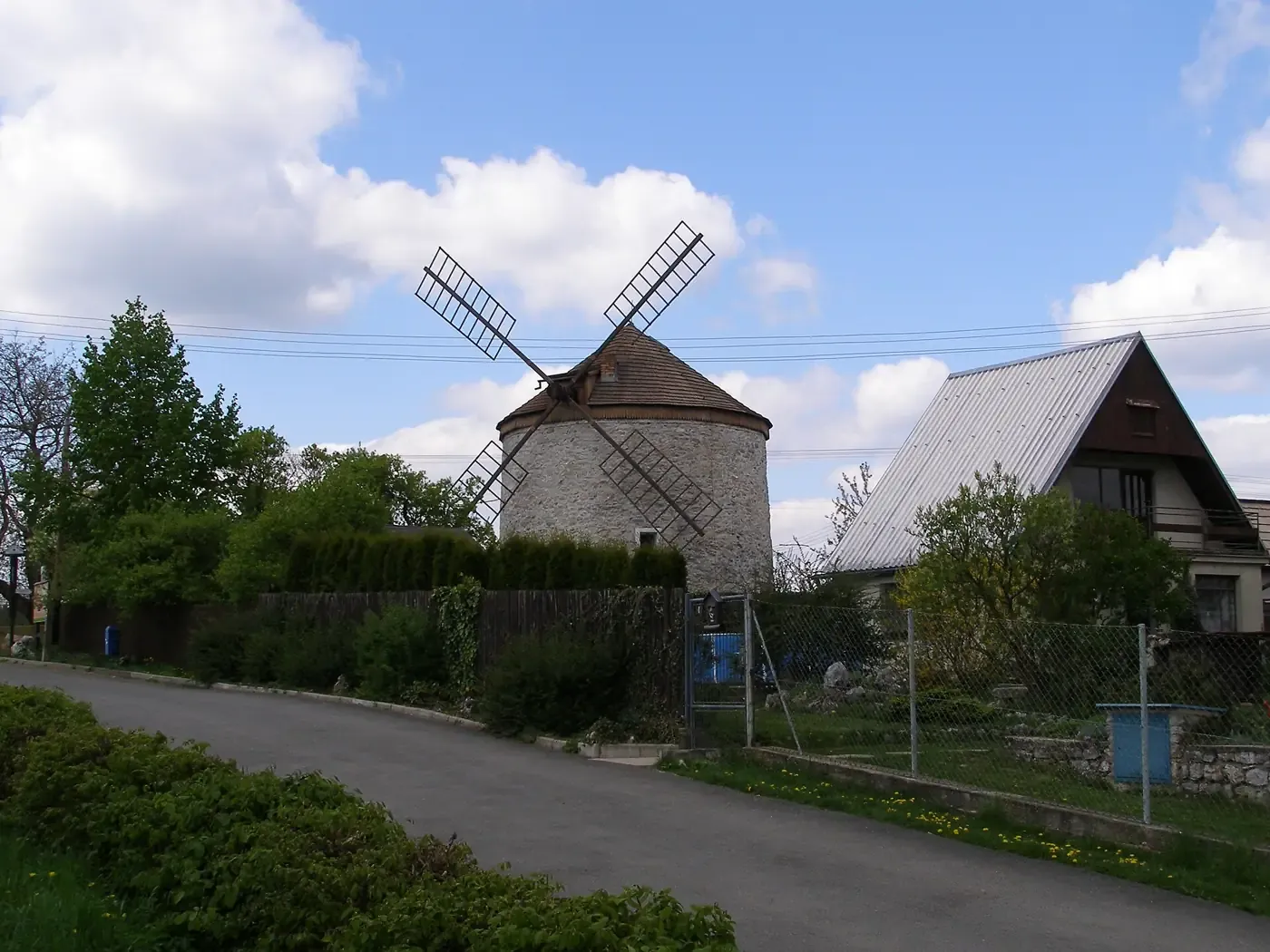
Rudice (population 950) sits geographically right in the middle of the Moravian Karst Protected Landscape Area. The village’s history is bound up with mining and metallurgy — and it’s here that the famous Rudice geodes are formed, hollow quartz nodules lined with amethyst crystals. A former windmill now houses a museum and geological geopark.
QUICK LINKS 💎 Why visit · 🕳️ The Rudice Sink · ❓ FAQ
Why visit
Rudice has probably been settled since the 9th century, when miners and metalworkers first put down roots here — indeed, the village’s very name hints at what its history revolves around. Ore was extracted here first by surface mining, and later from shafts over a hundred metres deep, right up until the turn of the 19th and 20th centuries.
The village’s landmark is a cylindrical stone Dutch-style windmill from 1865, which today houses a museum of local history with a permanent exhibition covering speleology, mineralogy, geology, and the history of metallurgy and mining. Right next to the windmill stands the Geopark, displaying rock samples arranged by age — a place where even complete newcomers can get a clear picture of the region’s geology. You’ll find more on the geodes themselves in a separate article.
The Rudice Sink and the Kolíbky amphitheatre
The area’s biggest draw is the rocky Kolíbky amphitheatre and the Rudice Sink (Rudické propadání), where the Jedovnický Stream disappears underground — the entrance to a 12-kilometre cave system, Rudické propadání–Býčí skála, the second-longest in the Czech Republic. The stream’s underground course tumbles through a series of waterfalls, the highest of which drops 35 metres. The Jedovnice Ponds–Rudice Sink nature trail leads visitors here directly from Jedovnice.
The Rudice Sink is one of the caves accessible on a speleological basis, without walkways, with a helmet and accompanied by a caver — see Caves Without a Guide.
Frequently asked questions
Can you go inside the Rudice caves? No, the Rudické propadání–Býčí skála system is not open to the public — it’s a protected site reserved for speleologists.
Is the windmill museum open all year round? Opening hours tend to be seasonal, so we’d recommend checking directly with the village for current times.
Can you still collect Rudice geodes today? The original deposits are almost exhausted now, with just one surface mine remaining at the Seč site — more on this in our article on the geodes.
Part of the series A Week in the Moravian Karst: a complete 7-day itinerary. More detail: Rudice Geodes. Sources: brochure by the Association for Rural Development of the Moravian Karst (published with support from the Czech Ministry for Regional Development). Village details may change over time — for current information, visit rudice.cz.
Complete 7-day itinerary — free
Get a detailed week-long plan sent to you: caves, Macocha, day trips, where to stay. The PDF arrives by email right away.